DIY Henna Onion Hair Oil for Hair Growth

(If you're here just for the preparation steps, feel free to skip ahead to the recipe section below!)
A few days ago, I had instructed the woman who usually brings me spinach and other greens (keerai) to also bring henna leaves. While heading to the park for my morning walk, she called out to me, saying she had brought the goods.
It wouldn’t be an exaggeration to say that I am a slave to henna. As a child, we had a henna tree in our house, but no one ever saw that tree full of leaves—because I would pluck them as soon as they sprouted! I would grind them into a paste and apply them to my hands, much to my mother’s annoyance because she had to help me apply it properly. The sight of my hands, adorned with circular patterns in the middle and caps on my fingertips, with a reddish-orange hue—not too light, not too dark—filled me with delight. My nails always had a coral shade.

If even leaves were hard to find on my hands, how could flowers ever survive? But henna flowers had an enchanting fragrance. There was a henna tree next to the house where I took music lessons. The scent of the blooming flowers would drift into my teacher’s living room. Even now, when I catch that fragrance, I am instantly transported back to my music teacher’s house.
Now, in the apartment where I live, there is no space for a henna tree. But whenever I ride my two-wheeler and spot a henna tree in someone’s yard, my hands itch to pluck the leaves! I have to control myself with great difficulty.
Although my childhood enthusiasm has diminished, I still depend on the spinach vendor to bring me henna leaves whenever possible. The simple act of receiving those leaves, however, often sets off a chain of thoughts—reminders of the past, of traditions, and of the ways natural remedies have always been woven into my life.
A Chance Encounter That Led to Hair Growth
Just yesterday, while sorting out curry leaves and thinking of all the amazing benefits they have for hair, my thoughts drifted to another memory. It was then that I realized how much hair care has always been a part of my life, just like my love for henna. This connection between natural remedies and tradition reminded me of a recent conversation with a friend—one that rekindled my interest in homemade hair oils.
Last week, after many months, I ran into a friend at the mall. She looked different, with a completely new hairstyle. It suited her well. Last year, she had mentioned that her son got a job in Kolkata, and she was planning to move there.
As soon as I saw her, I exclaimed, “Jaya! You’ve completely changed after moving to Kolkata… even your hairstyle is different!”
She immediately replied, “Enough! My hair started falling out after using so much hair color. Now, I even have bald patches here and there. So, I had to do something to cover them up.”
It felt as if she was speaking directly to me because I was facing the same issue. That’s when I remembered how my father used to heat oil and massage it onto our scalps when we were kids. On the first day, he would heat fenugreek, cumin, and a whole red chili in sesame oil. The next day, he would gently apply it to our heads, massaging in small, circular motions. By the time he was halfway through, sleep would take over our eyes.
As I pondered what to do, an idea struck me—not an apple falling from a tree, but a gooseberry! “Eureka!” I mentally exclaimed and began preparing for an oil-heating experiment. Everything started coming together in my mind.
Homemade Hair Oil for Stronger Hair
Ingredients:
Henna leaves (about 2 cups)
Curry leaves (about 2 cups)
Gooseberry (about a dozen)
Pearl onions (4-5)
Fenugreek (1 teaspoon)
Cumin (half a teaspoon)
1 dried (whole) red chili with stem
Cold-pressed coconut oil (or wood-pressed coconut oil)
Method:
Prepare the Ingredients:
Wash the gooseberries well and dry them completely. I chopped them and dried them in the sun
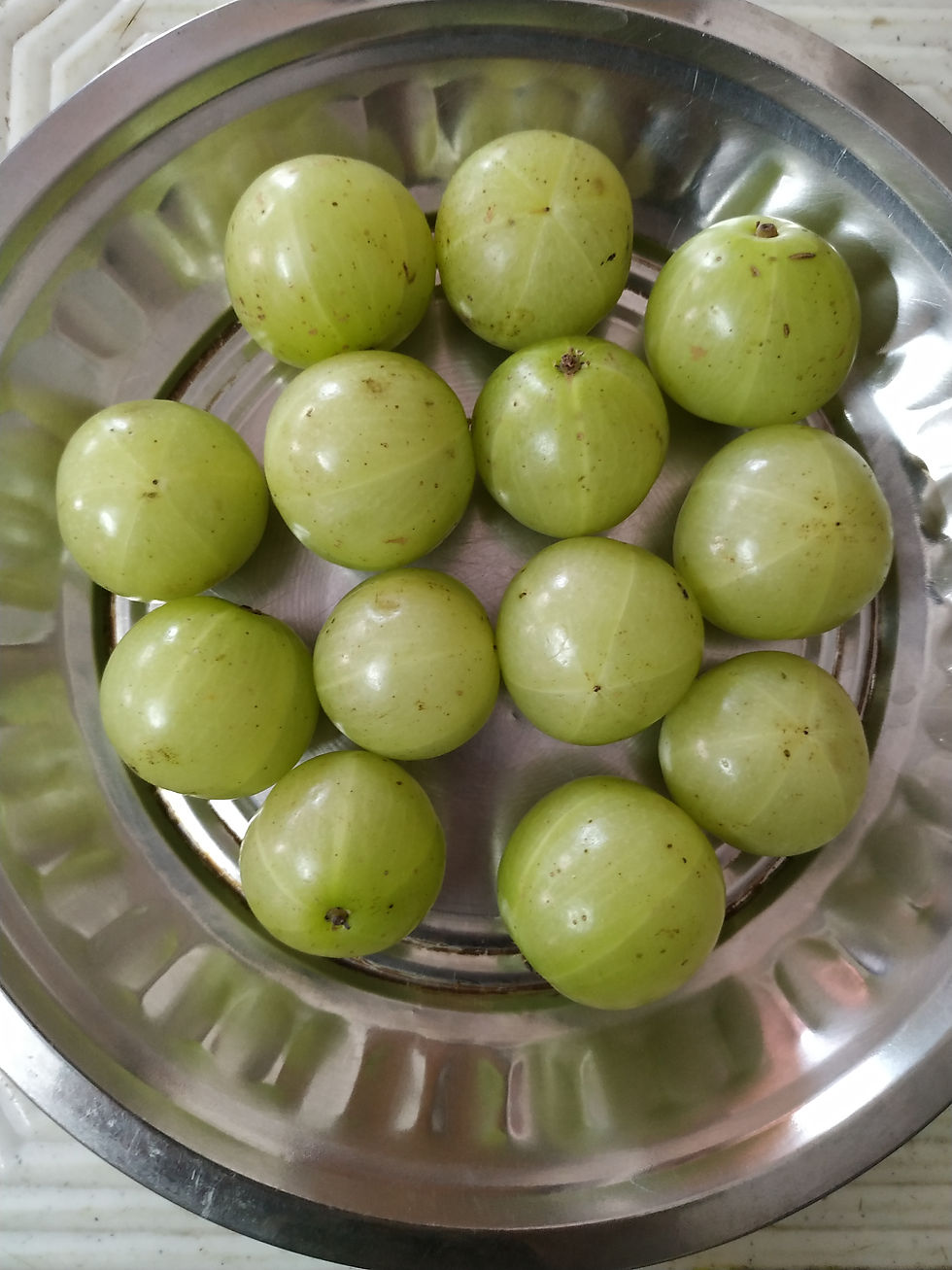
Gooseberry or Nellikkai, also known as amla Once dried, they will probably look like this:

Sun dried amla Peel and chop four to five pearl onions.
Thoroughly wash the henna and curry leaves, then grind them in a mixer.


Curry leaves and henna ground into a paste Shape the paste into small patties and dry them in the sun.

Once dried, they would look like this

Heating the Oil:
In a pan, heat a ladle of cold-pressed coconut oil.
Once slightly warm, add fenugreek, cumin, the red chili, chopped onion pieces, two dried curry leaf and henna patties, and four to five dried gooseberry pieces.

Heat until the mixture turns golden brown, then turn off the stove.

Storage & Application:
Let the oil sit overnight to absorb all the nutrients.
Strain the oil before applying.

Final product sample after straining Gently massage the oil into your scalp, ensuring it reaches the roots.
Leave it on for at least an hour before washing.
My Experience and Results
Initially, I was worried that the onion would leave a strong smell on my hair. But after washing with shampoo, there was no trace of any unpleasant odor. Additionally, I have never faced any type of stinging or burning because of the chilli. The key here is to make sure it is intact and the seeds are not too exposed.
This oil first stops hair fall. Then, you can actually see new hair growth. I have personally experienced this, and I hope you find it helpful too!


Healthy medicine for hair. Thanks for sharing Bhu dear
👍🏻😄way to go, Bhuvana!! ....Anupama
Beautiful Bhuvana :)